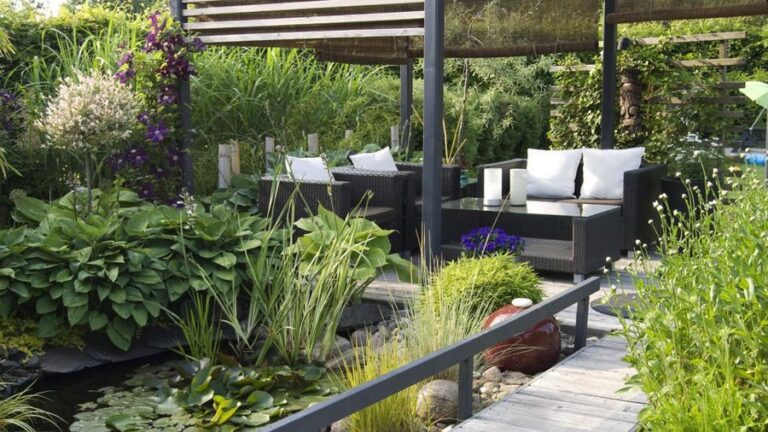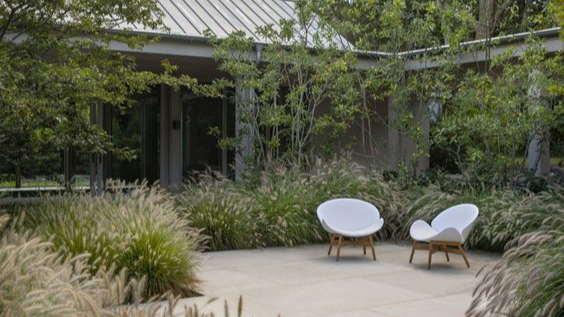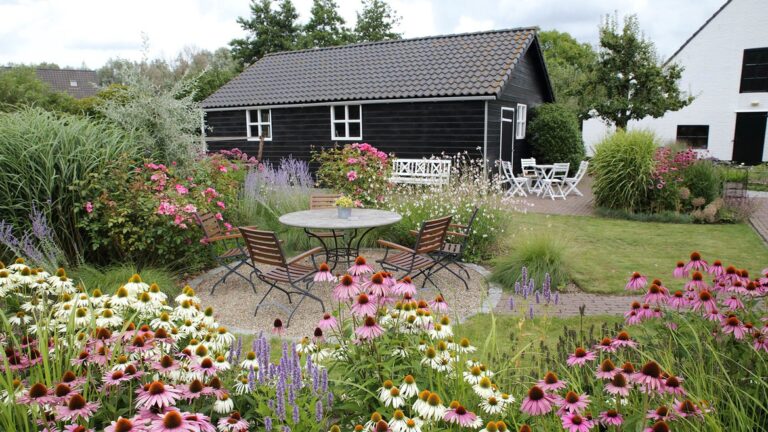

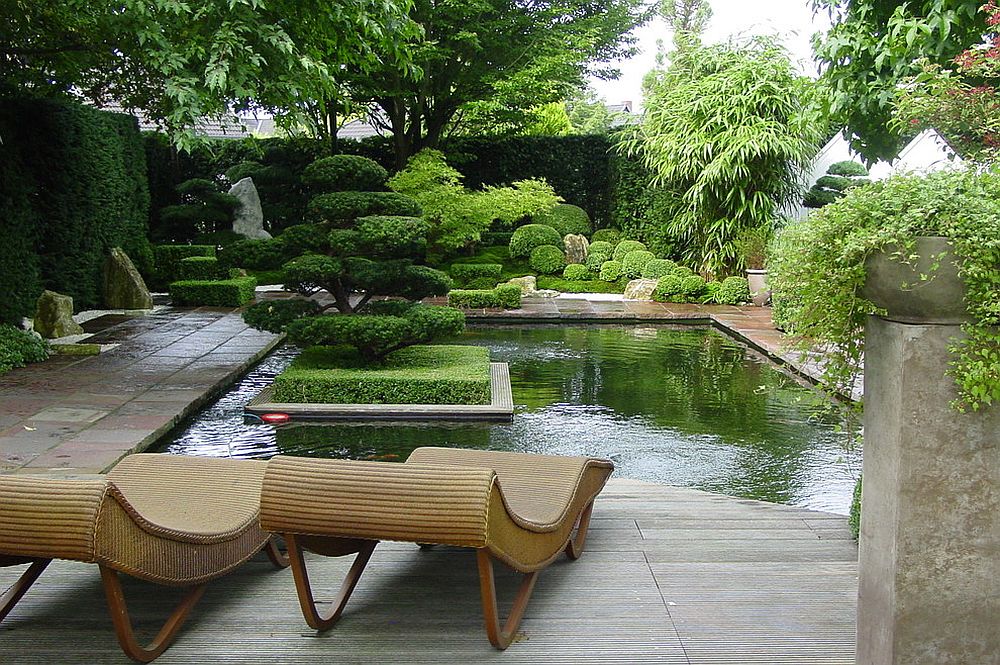
A modern Japanese garden is a contemporary interpretation of Eastern aesthetics, where traditional philosophy is expressed through minimalist, architectural form. Decorative excess is deliberately avoided, and space is shaped through proportion, materiality, and consciously preserved emptiness.
Unlike the traditional Japanese garden, the modern version relies less on symbolism and more on spatial clarity. The composition is based on refined forms, clean planes, and the relationship between light and shadow. Plants are used not as abundant displays, but as structural elements — masses or sculptural accents that highlight architecture.
This is a garden where the essential dialogue is between filled and empty space. Tranquility is achieved not through ornament, but through order.
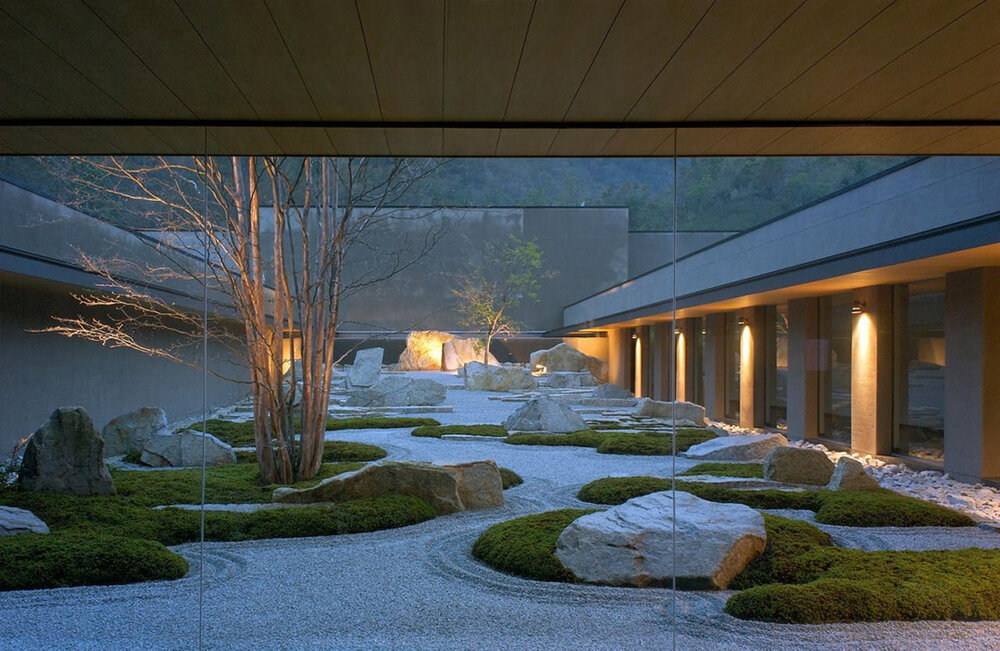
Characteristic Elements
• Geometrically shaped spaces and clearly defined compositional axes.
• Planar surfaces of stone, concrete, or other natural materials.
• Minimalist reflecting pools or still water surfaces.
• Stylized stone compositions.
• Wooden or concrete terraces without decorative detailing.
• Integrated architectural lighting that emphasizes form and texture.
• Open, visually light spaces with clearly defined boundaries.
Insight: When designing a modern Japanese garden, restraint is essential. Too many materials or competing forms can dilute the clarity of the composition. In this style, strength lies not in abundance, but in proportion.
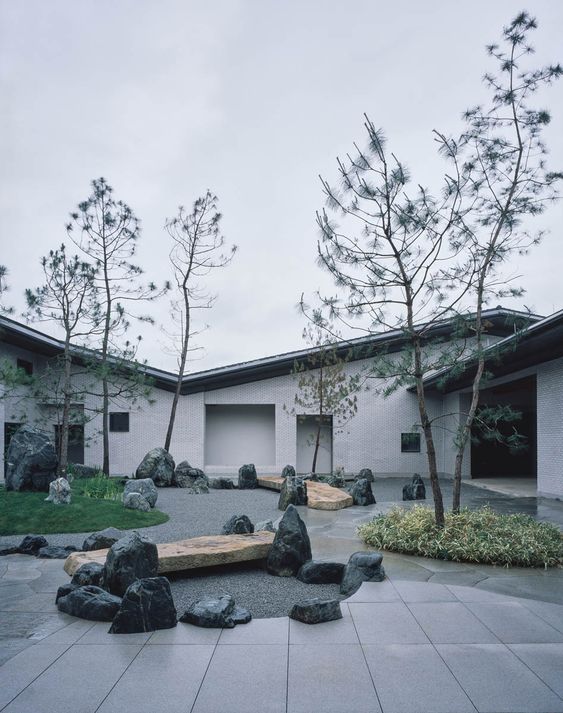
Characteristic Plants
• Subtly shaped trees following the niwaki principle — pines, yews, maples.
• Japanese maples used as sculptural focal points.
• Unified masses of a single plant species, creating a calm background.
• Low, textural groundcover plants.
• Ornamental grasses introducing subtle movement.
• A limited number of flowering plants, emphasizing foliage form and silhouette.
In Lithuanian conditions, careful evaluation of microclimate and frost hardiness is crucial — a minimalist composition does not tolerate plant loss or arbitrary substitutions. Long-term planning and appropriate species selection are therefore especially important.
A modern Japanese garden is a balanced composition of restraint and clear structure, where architecture and landscape merge into a unified space. Its essence lies in the relationship between filled and empty planes, between material and silence. Here, tranquility emerges from moderation and consciously limited design decisions.